
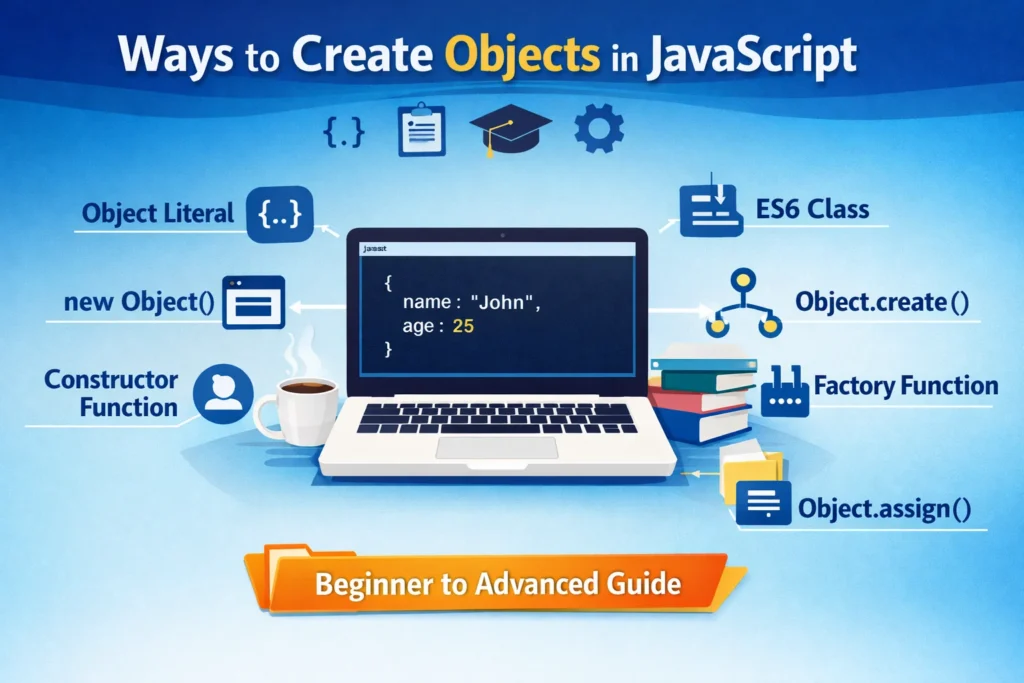
JavaScript is one of the most popular programming languages used for web development. One of the most important concepts in JavaScript is objects.
Objects allow developers to store multiple values and functions inside a single variable. Almost everything in JavaScript revolves around objects, including arrays, functions, and even dates.
In this guide, we will explore the different ways to create objects in JavaScript, starting from beginner-friendly methods and moving toward advanced techniques used by experienced developers.
What is an Object in JavaScript?
An object is a collection of key-value pairs.
Each key is called a property, and the value can be a string, number, array, function, or another object.
Example:
const user = {
  name: "Technical Mickey",
  age: 25,
  isAdmin: false
};

console.log(user.name);Output:
Technical MickeyObjects help organize data in a structured way.
1. Creating Objects Using Object Literals (Most Common Method)
The object literal method is the easiest and most widely used way to create objects in JavaScript.
Example:
const person = {
  name: "Mickey",
  age: 28,
  profession: "Developer"
};

console.log(person.name);Why use Object Literals?
✔ Simple and readable
✔ Best for small projects
✔ Quick object creation
Most beginners start learning objects using this method.
2. Creating Objects Using the new Object() Constructor
Another way to create an object is by using the built-in Object constructor.
Example:
const person = new Object();

person.name = "Mickey";
person.age = 28;
person.profession = "Developer";

console.log(person);Although this works perfectly, developers usually prefer object literals because they are shorter and cleaner.
3. Creating Objects Using Constructor Functions
Constructor functions allow you to create multiple objects with the same structure.
Example:
function Person(name, age) {
  this.name = name;
  this.age = age;
}

const user1 = new Person("Technical", 25);
const user2 = new Person("Mickey", 30);

console.log(user1.name);This method was widely used before ES6 classes were introduced.
4. Creating Objects Using ES6 Classes
Modern JavaScript introduced classes, which provide a cleaner way to create objects.
Example:
class Person {
  constructor(name, age) {
    this.name = name;
    this.age = age;
  }
}

const user = new Person("Technical Mickey", 28);

console.log(user);Benefits of Classes
✔ Cleaner syntax
✔ Easy to manage large applications
✔ Supports inheritance
Classes are widely used in React, Node.js, and modern JavaScript frameworks.
5. Creating Objects Using Object.create()
The Object.create() The method allows you to create objects with a specific prototype.
Example:
const personPrototype = {
  greet() {
    console.log("Hello!");
  }
};

const person = Object.create(personPrototype);

person.greet();This method is commonly used when working with prototypal inheritance.
6. Creating Objects Using Factory Functions
A factory function returns an object instead of using the new keyword.
Example:
function createUser(name, age) {
  return {
    name: name,
    age: age
  };
}

const user = createUser("Technical Mickey", 28);

console.log(user);Advantages
✔ More flexible
✔ No need for new keyword
✔ Easier to control object creation
Many modern JavaScript developers prefer factory functions.
7. Creating Objects Using Object.assign()
The Object.assign() The method is used to copy properties from one object to another.
Example:
const obj1 = {
  name: "Technical Mickey"
};

const obj2 = {
  age: 28
};

const user = Object.assign({}, obj1, obj2);

console.log(user);Output:
{ name: "Technical Mickey", age: 28 }This method is useful when merging multiple objects.
Comparison of Object Creation Methods
| Method | Best For |
|---|---|
| Object Literal | Simple objects |
| new Object() | Rarely used |
| Constructor Function | Multiple similar objects |
| ES6 Classes | Modern applications |
| Object.create() | Prototypes |
| Factory Functions | Flexible object creation |
| Object.assign() | Merging objects |
Best Way to Create Objects in JavaScript
There is no single “best” method, but developers commonly use:
- Object literals for simple objects
- Classes for large applications
- Factory functions for flexible object creation
Choosing the right method depends on your project requirements.
Conclusion
JavaScript provides several ways to create objects, each designed for different use cases.
For beginners, the object literal method is the easiest to understand. As you move to more advanced JavaScript development, techniques like classes, factory functions, and Object.create() become more useful.
Understanding these methods will help you write cleaner, scalable, and maintainable JavaScript code.