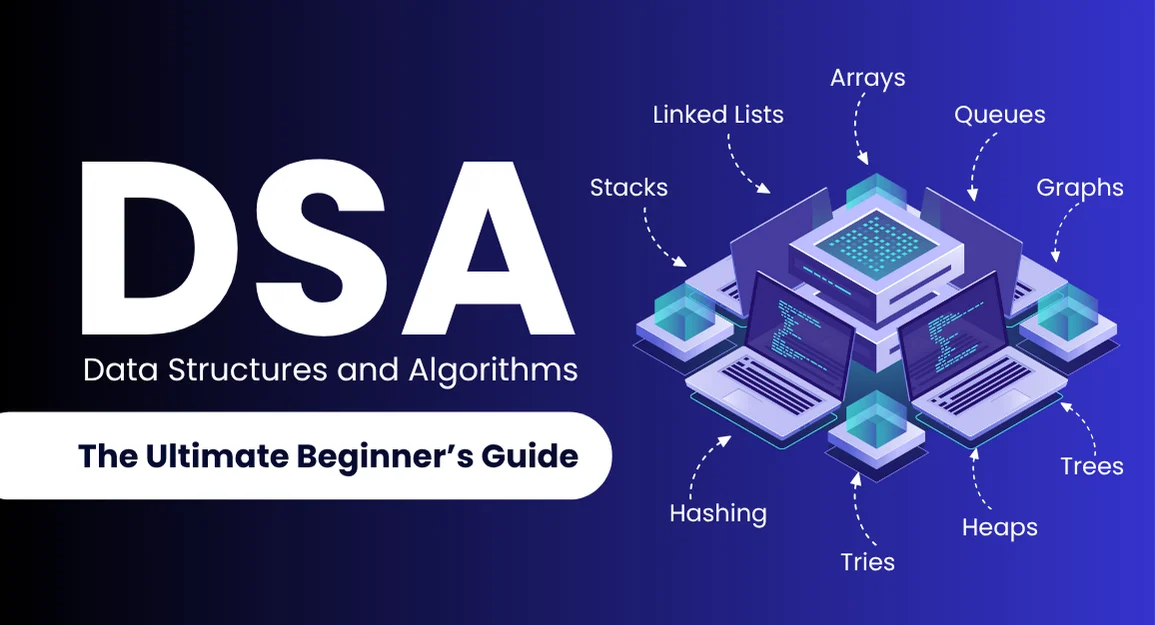


DSA Tutorial

Last Updated: April 30, 2025

Data Structures and Algorithms (DSA) form the backbone of modern software development and competitive programming. Knowing how to organize data and solve problems efficiently can set you apart in tech interviews and real-world projects. With 2025 bringing new trends and updates, mastering DSA is more important than ever. It boosts your problem-solving skills, makes your code faster, and opens up more career opportunities.

What Are Data Structures and Algorithms?

Definition and Purpose

Data structures are ways to organize and store data so it can be accessed easily and quickly. They act like containers or systems for your data—arrays, linked lists, trees, and more. Algorithms are step-by-step instructions to solve problems or perform tasks efficiently. Think of recipes or instructions that guide your computer to get things done.

Role in Software Development

Good data structures and algorithms improve how applications perform, especially when handling large data. For example, search engines use advanced algorithms to fetch results fast. Database systems rely on efficient indexing, which is a mix of proper data structures and algorithms. Operating systems manage resources by choosing the best algorithms for task scheduling. They make software smoother and more scalable.

The Foundation of Computer Science

Understanding DSA is key for technical interviews, coding competitions, and many software roles. It’s like learning the rules of a game—once you know them, you can solve complex problems easily. Learning DSA also helps in developing logical thinking, making you a better coder and thinker.

Essential Data Structures

Arrays and Strings

Arrays store items next to each other in memory, making them quick for read and write operations. Strings are sequences of characters, a special type of array. They are vital in managing user profiles, messages, or product lists in social media apps. Operations like adding, deleting, or searching are common with arrays.

Linked Lists

Linked lists are flexible structures where each item points to the next one. A singly linked list points forward only, while a doubly linked list points both ways. They work well in applications like dynamic memory management or implementing stacks and queues. They allow easier insertion or deletion compared to arrays.

Stacks and Queues

Stacks follow Last-In, First-Out (LIFO) order—think of a stack of plates. They’re used in undo features and expression evaluation. Queues follow First-In, First-Out (FIFO)—like a line at a store. They help manage processes, such as scheduling tasks in an operating system.

Trees and Graphs

Trees are hierarchical structures—think family trees or company charts. BSTs, or Binary Search Trees, help in quick searching. Graphs connect data points, like social networks or maps. They’re used for network routing, where the goal is to find the shortest path or the best connection.

Hash Tables

Hash tables store data with a key for fast lookup, like a dictionary. Collisions happen when two keys hash to the same position; special techniques handle this. They’re used in caching, database indexes, and quick searches.

Core Algorithms and Their Applications

Sorting Algorithms

Sorting organizes data for easier use. Bubble sort and selection sort are simple but slow. Quicksort and merge sort are faster options suitable for large datasets. Depending on your needs, choosing the right sorting algorithm makes your code efficient.

Searching Algorithms

Linear search looks through data one by one—simple but slow. Binary search quickly finds items in sorted data, much like looking in a dictionary. These techniques are essential for databases and lookup systems.

Recursion and Backtracking

Recursion solves problems by breaking them down into smaller versions. Backtracking explores different options, useful in puzzles like Sudoku or the N-Queens problem. These methods often generate solutions by trial and error.

Dynamic Programming

Dynamic programming breaks complex problems into simpler subproblems, solving each once and storing the results. It’s great for optimization problems like the knapsack or finding the shortest paths in graphs.

Greedy Algorithms

Greedy algorithms make the best choice at each step to reach the optimal solution. For example, in activity selection or minimum spanning trees, they quickly find efficient results by choosing locally optimal options.

Advanced Concepts and Techniques

Time and Space Complexity Analysis

Understanding Big O notation helps you measure how fast an algorithm runs and how much memory it uses. A good grasp of efficiency guides you in writing optimized code, especially for large data.

Data Structure Design and Implementation

Sometimes, existing structures don’t fit your specific needs. Building custom data structures tailored to your problem can boost efficiency and simplify complex tasks.

Graph Algorithms

Dijkstra’s, Bellman-Ford, and Floyd-Warshall are popular algorithms for finding shortest paths in graphs. They power navigation apps, network design, and logistics planning.

Divide and Conquer Strategy

This approach divides large problems into smaller, manageable parts, then combines solutions. QuickSort and Merge Sort are classic examples. It’s a powerful way to speed up problem-solving.

Bit Manipulation

Bitwise operations modify data at the binary level, which can lead to faster computations. They are used in cryptography, error detection, and compression techniques.

Practical Tips for Learning DSA

  • Practice regularly on platforms like LeetCode, Codeforces, and HackerRank.
  • Break problems into smaller pieces to understand their core logic.
  • Spot common problem patterns and learn to solve variations.
  • Study solutions from top programmers to improve your skill.
  • Stay updated with the latest trends and new algorithms in DSA.

Real-World Use Cases of DSA

Big companies heavily rely on optimized algorithms to process millions of data points daily. For example, Google’s search ranking depends on complex algorithms for relevance. Amazon uses smart data structures for product recommendations. Social networks analyze vast graphs to suggest friends or content. Using the right data structures and algorithms makes these platforms fast and user-friendly.

Conclusion

Mastering DSA is essential for anyone looking to grow in tech. The right data structures form the foundation of good software, while smart algorithms help your programs run faster. Keep learning, practicing, and solving new problems. This continuous effort will open doors to exciting opportunities and help you become a better programmer. The journey is long, but each step makes a difference.

References and Further Reading

  • Official tutorials on platforms like LeetCode and HackerRank
  • “Introduction to Algorithms” by Cormen et al. — a foundational book in the field
  • “Data Structures and Algorithms Made Easy” for beginner to advanced concepts
  • Explore the latest updates and trends in DSA for 2025 through reputable tech blogs and forums